
Claims
Claims are statements that are either true or false. Only true statements can be validated and settled on Fast.
In this lesson, you will learn about claims, what they are and who produces them. If you’re interested in the validation or settlement process, read our tutorial on the Fast protocol.
What are claims?
Section titled “What are claims?”Claims are statements that are either true or false. They can be verified by external third parties and then settled on Fast. They may carry additional evidence to support the verification process, but any discussion on how that is handled is outside the scope of this tutorial.
Before a claim is validated and settled, it can optionally go through a verification phase performed by verifiers. These are specialized clients that confirm whether the claim’s data or proofs are valid.
These verifiers act as customizable verification services that can perform checks like:
- Cryptographic or ZK proof validation
- TEE (Trusted Execution Environment) attestation
- Semantic or domain-specific validation of computations or contracts
Once a verifier confirms a claim’s correctness and issues a signed proof, the claim can then be processed by validators for settlement.
This separation of verification and validation allows applications to handle complex or computation-heavy verification tasks off-chain or on parallel services, keeping the Fast core lightweight and scalable.
The simplest type of claims are signatures, where the statement is signed by a signer:
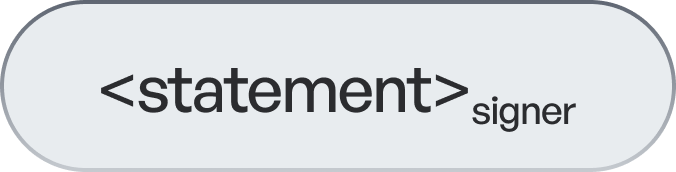
For example, the signature below:

states that I, Grigore, pay Xiaohong 10 USD.
More generally, a claim referring to a payment transaction would be a signature by $sender

which specifies $sender is transferring $value tokens to $recipient.
Payments are claims because they state the change of asset balances. However, claims are not just about payments. Voting, escrow, verifiable computing, custom assets, auctions, app-chains or blockchains are all examples of claims and all of them are supported by Fast.
Let’s be more specific and take a look at a few other examples of claims you can settle in Fast.
- I am Grigore Rosu - a fact where the signer is important
- Pythagoras theorem - a fact where the signer is less important
- The price of gold is 100 USD - an oracle
- The next random number is 17 - a verifiable random function
- I want to buy a ticket to the Iron Maiden concert - an intent
- The result of your query is 42 - an AI service provided
- Python program fibonacci on input 10 evaluates to 55 - the result of a computation requiring re-execution or a mathematical or zero-knowledge (ZK) proof based on Python formal semantics
- My Angry Birds score is 739 - a fact requiring a 3rd party or ZK proof
- My next move in this chess game with Alice is Nf3 - a fact modifying a shared storage location sequentially
- I vote YES for that petition - a fact modifying a shared storage location non-sequentially
Who produces claims?
Section titled “Who produces claims?”Users write claims and send them to Fast for validation and settlement. However, users can also write messages that instruct the Fast validators on how to generate their claims.
Fast allows two types of accounts, similarly to Ethereum: user-owned accounts and contract-based accounts. Claims can be initiated directly from a user-owned account and indirectly by the validators through contract-based accounts.
Accounts are required to sign any claims they issue, and these signatures allow validators to confirm both the authenticity and integrity of the claim.